March 16, 2012
·
answers, logic, math puzzles, numbers, The Mathcast
We all know this feeling: someone’s in your seat, and now you’re the nutcase who’s going to take someone else’s seat. After all that what’s the probability the last person on the plane will be able to sit in the correct seat?
The three number trick is just a simple version of this one (but here it is quicker and simpler).
Permalink
May 9, 2010
·
Favorites, guests, logic, math puzzles, Mathfactor Events, paradoxes, Podcasts, The Mathcast
Greg Chaitin, author most recently of MetaMath!, discusses the ubiquity of undecidability: incredibly all kinds of mathematical and physical systems exhibit utterly unpredictable, baffling behavior– and it’s possible to prove we can never fully understand why!
Permalink
March 28, 2010
·
Favorites, guests, infinity, logic, Mathfactor Events, numbers, paradoxes, Podcasts, The Mathcast, toys and math products
Quick interviews with folks here at the Gathering For Gardner, including Stephen Wolfram, Will Shortz, Dale Seymour, John Conway and many others.
Permalink
February 26, 2010
·
answers, guests, logic, math puzzles, numbers, Podcasts, The Mathcast
A bit lazy, but we’re pretty far behind. Herewith, are
GP: Switcheroo!
GQ: Durned Ants
GR: VIth Anniversary Special
GS: I Met a Man
Permalink
July 28, 2009
·
answers, guests, logic, math puzzles, numbers, The Mathcast, Yoak
Man, what is it with puzzlers and prisoners? Jeff Yoak lines ’em up and the stakes are high in this week’s puzzle.
Also, we are now twittering at MathFactor; each of the authors has an account of his own; mine is CGoodmanStrauss. You can tag solutions and comments with #mathfactor. See you there!
Permalink
July 28, 2009
·
answers, guests, logic, math puzzles, numbers, The Mathcast, Yoak
How can three people, each required to guess the color of hat on their head, strategize and maximize the chances they’ll all be right?
Permalink
December 1, 2008
·
Favorites, logic, math puzzles, The Mathcast, toys and math products
Our favorite new and not-so-new products of 2008!
Check out these great gifts!
- Zome is an incredibly powerful construction system!
- the great puzzles of Puzzellation (available at Barnes and Nobles)
- The terrific puzzle computer game DROD
- The Magic Mirror Image Coloring Book
- The Riddles of the Sphinx by David J Bodycombe, an amazing compendium of puzzles, of hundreds of kinds, at all levels of difficulty, with historical essays to boot!
- Which leads us to Nikoli, the great Japanese puzzle co! (Rules can be found here)
- The Princeton Companion to Mathematics is a landmark classic. A must-have for every serious student, researcher or amateur.
- How Round is Your Circle just one of the many fantastic titles out on Princeton University Press
- AK Peters is another fantastic press, with a wide range of interesting math and CS titles, including, ahem, the Symmetries of Things.
- Binary Arts/ThinkFun is another source of great puzzles!
- And the authors Martin Gardner and Ivan Moscovitch are always fantastic!
Hope this helps and have fun!! Let us know how it works out!
Happy Holidays from the Math Factor!
Permalink
August 16, 2008
·
answers, Follow Up, infinity, logic, paradoxes
That the worm falls off the end of the rope depends on the fact that the incredible
harmonic series
1 + 1/2 + 1/3 + 1/4 + . . .
diverges to infinity, growing as large as you please!
Read the rest of this entry »
Permalink
August 12, 2008
·
Favorites, guests, infinity, logic, math puzzles, numbers, paradoxes, The Mathcast, Topology and geometry
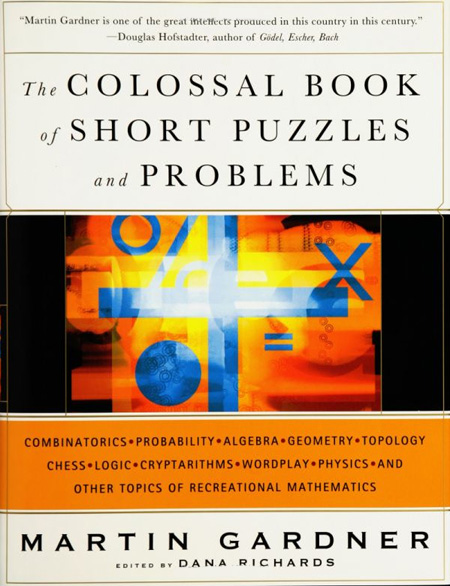
Dana Richards, editor of The Colossal Book of Short Puzzles and Problems discusses the amazing Martin Gardner and his legacy!
Permalink
July 1, 2008
·
logic, numbers, paradoxes, The Mathcast
Faster than an exponential! More powerful than double factorials!! The Busy Beaver Function tops anything that could ever be computed– and we mean ever
Permalink

 The Math Factor in iTunes
 RSS feed
 Comments RSS
 mathbun.com